
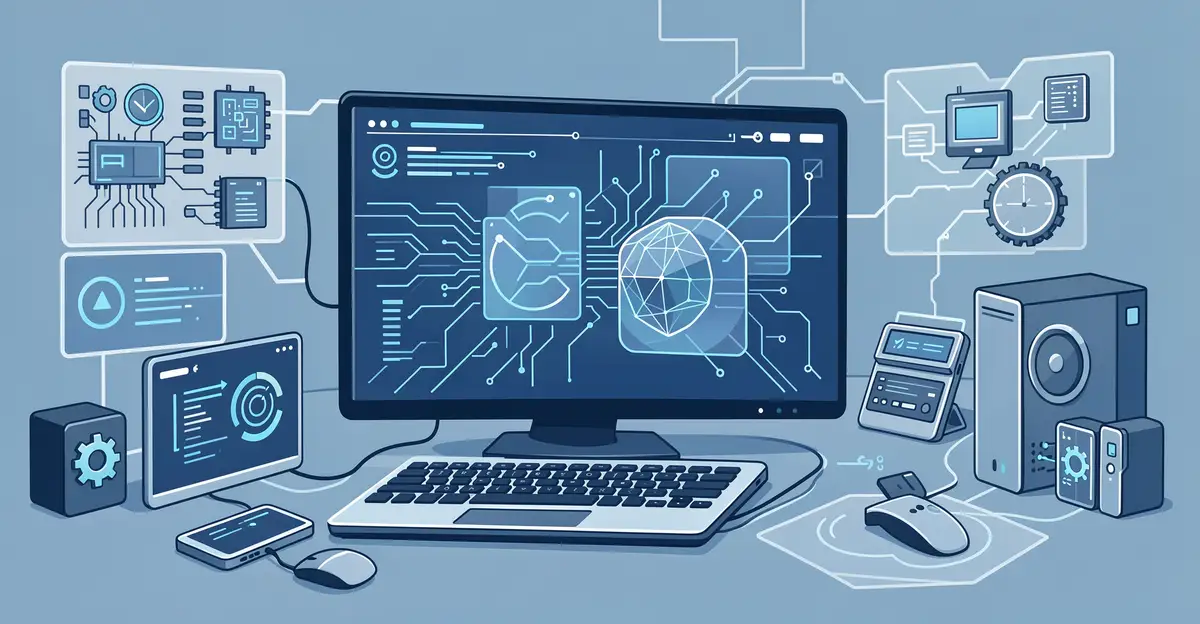
Computers already shape how we work, learn, and connect, but the next wave of innovation promises far bigger changes. From quantum machines that solve problems in seconds to brain-computer interfaces that translate thought into action, emerging computer technologies are moving from research labs into real-world applications faster than most people expect.
In this article, we break down the key technologies worth watching, explain what each one actually does, and show how they could affect your daily life and career. No hype, no jargon—just clear, actionable insight to help you stay ahead of the curve.
Introduction
Every few decades, a cluster of technologies arrives that doesn’t just improve existing products — it reshapes what computers can do, where they run, and who benefits from them. Today, that cluster includes quantum computing, neuromorphic chips, edge intelligence, photonic interconnects, and brain-inspired computing architectures. Each of these could change how we work, communicate, and solve problems within the next ten to twenty years.
This article explores Emerging Computer Technologies That Could Change the Future with clear, practical guidance. Rather than treating these advances as distant science fiction, we’ll look at what they actually are, what they can realistically do, and how you can prepare for their arrival whether you’re a student, a professional, a business owner, or simply a curious reader.
Understanding the fundamentals of Emerging Computer Technologies That Could Change the Future helps you make informed decisions. When you know the difference between a marketing buzzword and a genuine architectural shift, you can invest your time, money, and attention more wisely. Reliable information and consistent habits lead to better long-term outcomes — and that principle applies just as strongly to technology literacy as it does to personal finance or health.
By the end of this guide, you’ll have a working mental model of the major emerging computing technologies, a practical step-by-step framework for engaging with them, and answers to the most common questions people ask when they first encounter this field.
Key Concepts
Before diving into specific technologies, it helps to understand the conceptual pillars that underpin them. These ideas recur across nearly every emerging computing platform.

Beyond Binary: New Computational Models
Classical computers process information as bits — zeros and ones. Emerging technologies fundamentally challenge this model:
- Quantum computing uses quantum bits (qubits) that can exist in superposition, representing multiple states simultaneously. This enables certain calculations to be performed exponentially faster than classical machines.
- Neuromorphic computing mimics the brain’s architecture using artificial neurons and synapses, processing information through spikes rather than clock cycles. This is far more energy-efficient for pattern recognition tasks.
- Photonic computing uses light instead of electricity to transmit and process data, offering enormous bandwidth with minimal heat generation.
- DNA computing leverages the storage and processing capacity of biological molecules, potentially packing vast amounts of data into microscopic spaces.
Compute at the Edge
Instead of sending all data to distant cloud servers, edge computing processes information locally — in your phone, car, factory sensor, or medical device. Combined with lightweight AI models, this reduces latency, improves privacy, and enables real-time decision-making where it matters most.
The Convergence Effect
Perhaps the most important concept is that these technologies don’t evolve in isolation. Quantum computers could accelerate drug discovery that feeds into neuromorphic health-monitoring wearables, which communicate via photonic networks. The real transformation happens when these fields intersect.
Key Terminology You’ll Encounter
- Qubit: The basic unit of quantum information.
- Tensor Processing Unit (TPU): Specialized hardware for machine learning workloads.
- Spiking neural network (SNN): A brain-inspired model used in neuromorphic systems.
- Latency: The delay between a request and a response — a key metric for edge and real-time systems.
- Hybrid architecture: A system combining classical and emerging processors to play to each one’s strengths.
Deep Dive
Let’s examine the most consequential emerging technologies in closer detail, including what they’re actually good for and where they currently fall short.
Quantum Computing
Quantum computers excel at specific problem classes: simulating molecules for drug and material discovery, optimizing complex logistics networks, and breaking certain cryptographic schemes. Major technology companies and startups have demonstrated increasingly powerful systems, though today’s machines remain noisy and error-prone.
What this means practically: quantum computing is not replacing your laptop. It’s a specialized accelerator accessed through the cloud. If your industry involves chemistry, finance, logistics, or security, it’s worth tracking — but there’s no need to panic about “Q-Day” tomorrow.
Neuromorphic and Brain-Inspired Chips
Conventional AI consumes enormous electricity. Neuromorphic chips, by contrast, process information event-driven, only when signals arrive, much like biological brains. This makes them ideal for always-on sensors in autonomous vehicles, robotics, and portable medical devices. Expect to see them first in embedded systems rather than general-purpose computers.
Edge AI and Tiny Machine Learning
Running AI models directly on small devices — a smart camera, a hearing aid, a farm sensor — is already happening. Advances in model compression and specialized microcontrollers mean that meaningful intelligence no longer requires a data center. Benefits include privacy (data never leaves the device), reliability (no network dependency), and speed (instant response).
Photonic and Optical Computing
Data centers already use fiber optics for communication; photonic computing extends light’s role to computation itself. Light-based matrix multiplication can perform AI inference with dramatically lower energy per operation. While general-purpose optical computers remain distant, optical accelerators for AI are already entering commercial deployment.
Advanced Materials and Beyond-CMOS Devices
Silicon transistors are approaching physical limits. Researchers are exploring carbon nanotubes, memristors, spintronics, and 2D materials like graphene to build faster, denser, and more efficient circuits. These may power the post-silicon era, though manufacturing at scale remains a significant hurdle.
Realistic Timelines
- Now to 3 years: Edge AI, optical interconnects, specialized AI accelerators.
- 3 to 7 years: Early commercial quantum advantage in niche fields, neuromorphic embedded systems.
- 7 to 15+ years: Fault-tolerant quantum computers, mainstream photonic computing, post-silicon chips.
Treat these as educated estimates, not guarantees. Technology timelines slip, and unexpected breakthroughs can accelerate them.
Best Practices
How should you engage with emerging computing technologies without wasting effort or falling for hype? These practices apply whether you’re an individual learner or leading an organization.
- Follow primary sources. Prefer peer-reviewed papers, official company technical blogs, and standards bodies over sensational headlines.
- Distinguish capability from promise. Ask: what has been demonstrated, on what scale, and under what conditions?
- Start small with pilots. Test emerging tools on low-risk projects before committing budgets or infrastructure.
- Invest in transferable fundamentals. Linear algebra, probability, programming, and systems thinking remain valuable regardless of which technology wins.
- Build a learning habit. Fifteen minutes of focused reading per day beats sporadic binge-learning. Consistency compounds.
- Watch the supply chain. Fab capacity, rare materials, and energy costs shape which technologies scale and when.
- Consider ethics and security early. Quantum-resistant cryptography, data privacy, and algorithmic bias should be designed in, not bolted on.
Step-by-Step: Engaging with Emerging Computing Technologies
Use the following framework to move from curiosity to confident, practical engagement.

Step 1: Understand the fundamentals
Begin by grasping core concepts: what qubits are, how neural networks learn, why edge computing reduces latency. You don’t need a physics degree. A few well-chosen articles, videos, and introductory courses will give you the vocabulary to evaluate new developments critically. Understanding the fundamentals of these technologies helps you make informed decisions about where to invest your attention.
Step 2: Assess your starting point
Evaluate your current knowledge, available time, budget, and technical environment. Are you a student exploring career paths, a developer seeking new skills, or a manager evaluating vendors? Honest self-assessment prevents you from overcommitting or underestimating the effort involved. Write down what you already know and what you specifically want to learn.
Step 3: Set clear goals
Vague ambitions like “learn about quantum computing” lead nowhere. Instead, set specific, measurable goals: “Complete an introductory quantum computing course within eight weeks and run three circuits on a cloud simulator.” Clear goals let you track progress and decide when to adjust course. Align them with your broader career or organizational strategy.
Step 4: Gather necessary resources
Identify the tools and materials you’ll need. These might include open-source quantum SDKs, cloud trial credits for AI accelerators, textbooks, online communities, or a mentor. Reliable information sources are critical — bookmark reputable journals, vendor documentation, and expert newsletters. Budget both time and money realistically; many excellent resources are free.
Step 5: Apply the core methods
Put knowledge into practice. Write code, build a small prototype, run experiments, or conduct a pilot within your organization. Hands-on experience reveals nuances that reading alone cannot. Start with well-scoped projects: simulate a quantum algorithm, deploy a tiny ML model to a microcontroller, or compare edge versus cloud latency for a real task.
Step 6: Monitor your progress
Review your goals regularly — monthly or quarterly. What have you learned? What obstacles appeared? What results did your pilot produce? Adjust your plan based on evidence rather than enthusiasm. Consistent monitoring turns scattered learning into durable expertise and helps you recognize when a technology is genuinely ready for wider adoption.
FAQ
What should I know about Emerging Computer Technologies That Could Change the Future?
The most important thing to understand is that these technologies are diverse and at very different maturity levels. Some, like edge AI, are already in products you use daily. Others, like fault-tolerant quantum computing, remain years away from broad impact. Focus on the underlying concepts — new computational models, energy efficiency, and decentralization — rather than chasing every headline. Reliable information and consistent habits lead to better long-term outcomes, so prioritize steady learning over hype cycles. Finally, remember that adoption depends as much on economics, regulation, and infrastructure as on technical breakthroughs.
Who is this guide for?
This guide is written for anyone seeking clear, actionable information about emerging computing technologies — students choosing a field of study, professionals looking to future-proof their careers, business leaders evaluating strategic investments, and curious general readers who want to separate genuine innovation from marketing noise. No advanced technical background is required, though a willingness to learn basic concepts will help you get more from the material. If you’ve ever wondered whether quantum computing, neuromorphic chips, or edge AI will affect your work or daily life, this guide is for you.
Conclusion
Emerging computer technologies — quantum, neuromorphic, photonic, edge, and beyond — represent genuine shifts in how computation happens. They promise faster problem-solving, dramatically lower energy use, and intelligence embedded everywhere. But they also demand patience: real adoption takes years, and hype often outpaces reality.
Your best strategy is neither to ignore these developments nor to chase every trend. Instead, build strong fundamentals, follow credible sources, run small experiments, and monitor results consistently.
You now have a solid foundation for Emerging Computer Technologies That Could Change the Future. Apply the best practices above and revisit this guide as your needs evolve.